
Real estate investment in Germany: An opportunity that can be worthwhile for capital investors
Germany is not only the land of poets and thinkers, but also a land of tenants. But why pay rent your whole life when you can also invest in real estate? Home ownership has always paid off, which is why we would like to take a closer look at real estate investment. Real estate is commonly referred to as 'concrete gold' due to its historically inflation-protected returns and its status as an increasingly sought-after tangible asset. Nevertheless, the decision to buy must be carefully considered.


A real estate investment is likely to be worthwhile—provided it is built on solid foundations.
According to the German Economic Information Service (IWD), around 16.4 million households in Germany live in owner-occupied residential property. In addition, there are just over five million private landlords who generate returns through ongoing rental income. The remaining housing stock is increasingly in the hands of private companies, cooperatives, or the public sector. Another point to consider is that most Germans are particularly conservative when it comes to investing money compared to other countries, meaning they are also very risk-averse. It is therefore hardly surprising that savings accounts and call money are the most commonly used forms of investment in this country. However, real estate ranks undisputedly in first place among tangible assets. Particularly in view of the recent sharp rise in rent levels across Germany, this highlights one of the major advantages of owner-occupied or rented real estate. There is no doubt that real estate investment is usually worthwhile from an economic perspective: historically, real estate has generated higher returns than, for example, call money and fixed-term deposit accounts, while at the same time offering protection against consistently rising rent levels when used for owner-occupancy. When rented out, real estate can also be managed in a tax-efficient manner. Of course, a frequently repeated investor principle also applies: people will always need somewhere to live, and real estate will therefore always be in demand. On the other hand, there are the commitments, usually spanning decades, that come with an externally financed real estate investment. But here, too, there are remarkable rays of hope for prospective owners: even after the recent rise in interest rates, construction financing is still cheaper than in the past when compared historically.
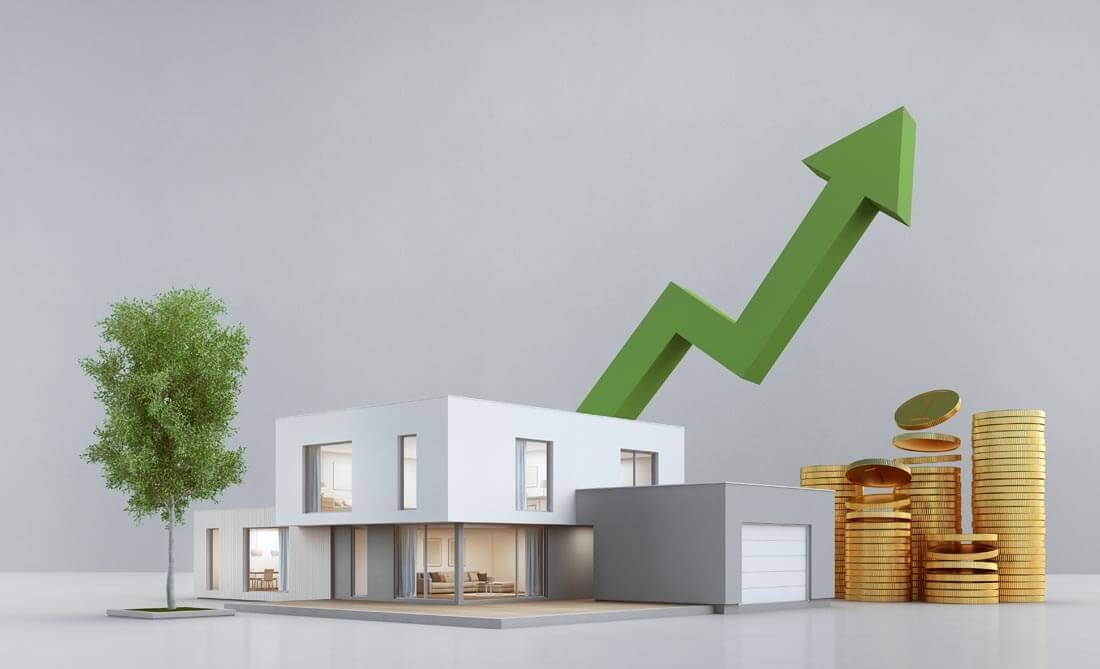
Structural and economic advantages of real estate investment
A real estate investment can certainly fulfill many functions. First and foremost, it should ensure internal, inflation-adjusted value retention. This means that the increase in value (and the income from a possible rental) exceeds the inflation rate—thus, purchasing power is at least maintained and, in the case of higher increases in value, even increased. In addition, unlike the public capital market in the form of stocks and ETFs, real estate is not subject to such strong fluctuations in value. Real estate investments also offer advantages from an economic perspective: although Germany is a country with a relatively older population by international standards, it continues to grow steadily due to immigration – at the same time, population density in many large cities has been increasing for many years. Residential real estate is therefore more in demand than ever, and experts are certain that this will not change in the foreseeable future. For investors considering a real estate investment, this means consistently high demand and, ideally, no or only short periods of vacancy. The tax treatment of real estate investments also plays into the hands of owners in Germany: when renting out a property, costs incurred, such as for renovations or necessary repairs, can be claimed as tax deductions—while the property itself initially experiences a non-taxable increase in value as a result of the measures taken. In addition, under certain conditions, if the property has been occupied by the owner at least part of the time, it can be sold completely tax-free after ten years – which also applies to the increase in value achieved to date.

Every real estate investment must be preceded by a thorough, objective, and professionally sound analysis.
Buying the proverbial 'pig in a poke' is rarely a good idea, especially when it comes to the sums involved in real estate, which usually require long-term loan commitments. Every real estate investment must therefore be preceded by many fundamental and specific considerations—starting, of course, with a sober assessment of one's own financial capabilities. The location and the property must be considered both in their current state and in terms of their future prospects. It is also important to consider whether the real estate investment will be used for personal use or rented out. In both cases, interested parties will review and evaluate the documents provided by brokers and real estate sellers for analysis. General information on living space, year of construction, building fabric, energy efficiency, and recent renovations and modernizations form the basis for this important analysis. When used for personal use, properties are usually held for longer periods of time, sometimes even used later for retirement or bequeathed to children. An alternative to this is real estate investment, which aims to generate short-term gains in value. To this end, the real estate investment is made and then invested in refurbishment and renovation. The property is later resold at a profit – but this is usually only possible with the relevant experience and specialist know-how.
Presenting the real estate investment in the best possible light when renting or selling later on
Those who already live in their dream house or apartment certainly have no reason to advertise the property publicly. The situation is different when it comes to upcoming property sales or planned rentals, which in turn involve finding tenants. In order to maximize the economic return, the property must be presented in an authentic yet appealing light. This is the only way to ensure that the property receives the attention it needs on the broader market for sale or rental. There are many ways to advertise a real estate investment in an appealing way. In addition to high-quality exposés and classic real estate photos, these include, for example, modern, intuitively understandable, and visually appealing floor plans, such as those produced by Grundriss Schmiede for owners and real estate agents. They help interested parties to get an idea of the property, its layout, and how the space can be used. At the same time, appealing floor plans, as well as photos and other presentation materials, are associated with value—and can thus have a sales-promoting effect or, for example, increase the likelihood of achieving the target rental price. Since the majority of real estate marketing is now done digitally, there are additional opportunities for promoting real estate investments—for example, virtual 360-degree tours, which are created using special software from many individual high-resolution images. This allows interested parties to virtually walk through their prospective real estate investment step by step to get an authentic first impression and a feel for the space. In turn, this reduces the often time-consuming 'viewing tourism' for current owners and brokers, while allowing interested parties to make an informed decision right from the start. Absolute precision and clear facts are always necessary when investing in real estate: if floor plans are not available or are insufficient, professional measurements should also be considered. Here, the floor plan experts support real estate agents and owners with the appropriate technology from Matterport.

Real estate funds – the alternative for real estate investment
You can invest in real estate without having to buy or maintain a property yourself. As an investor, you make either a one-time or regular payment into a fund, for example through a savings plan. In return, you receive shares in the fund, which invests the money in real estate. You essentially become a co-owner of a property and receive a certificate in return. The fund can buy, rent, or resell real estate or land in order to achieve a better return. The profits generated in the process are distributed among the investors. Real estate funds are not risk-free and are also considered an expensive form of investment. Therefore, you should carefully define your investment goals and risk tolerance in advance in order to plan your real estate investment to be as promising and profitable as you desire. A scale from 1 to 7 has been developed for risk assessment, with 7 representing the highest investment risk. This information serves as an initial guide. Please obtain comprehensive information before investing your money.
All information has been compiled to the best of our knowledge. However, we cannot accept liability for the details.